Amir Krüger · 4 September 2026
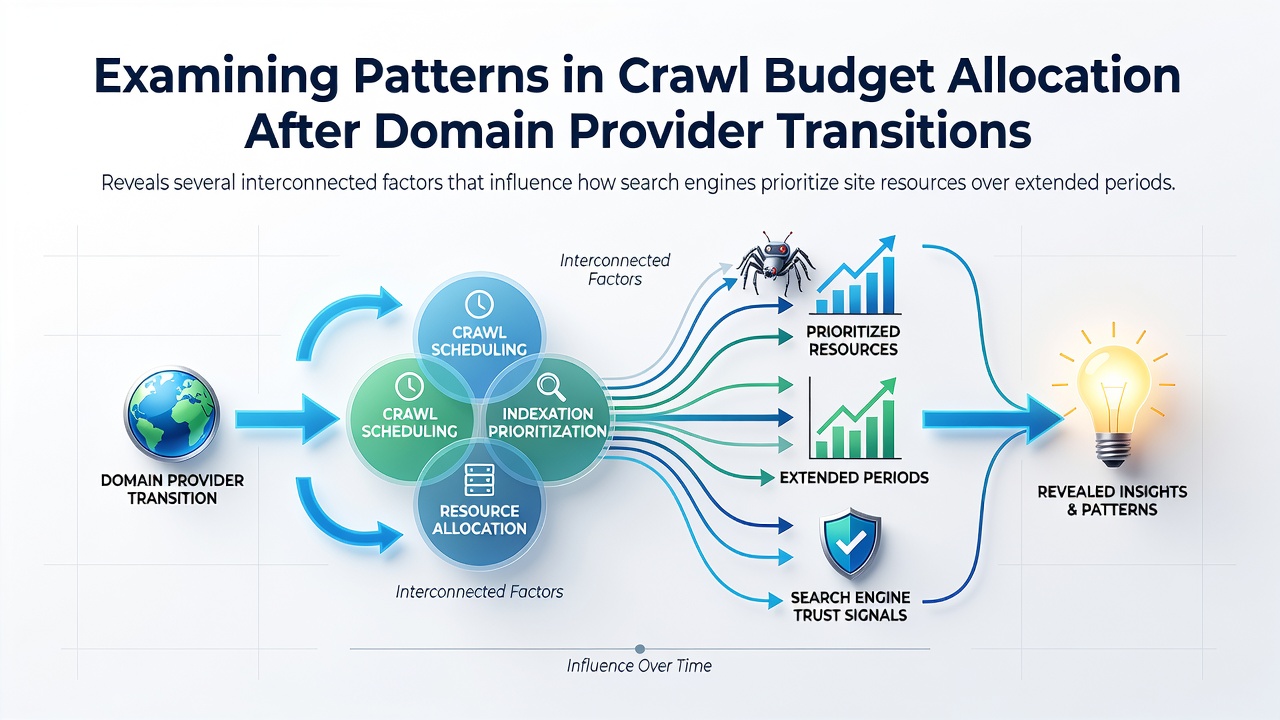
Examining Patterns in Crawl Budget Allocation After Domain Provider Transitions Reveals several interconnected factors that influence how search engines prioritize site resources over extended periods.
Domain provider transitions often trigger measurable shifts in how search engines distribute crawl resources across websites, and these changes unfold across weeks or months rather than appearing instantly. Observers note that factors such as DNS propagation delays, server response consistency, and updated sitemap submissions combine to reshape allocation patterns, while site architecture and historical crawl data continue to play ongoing roles. Research indicates that large-scale sites experience more pronounced adjustments because their existing crawl quotas already sit at higher baselines before any move occurs.
Core Elements of Crawl Budget Dynamics
Search engines assign crawl budgets based on a combination of host load capacity and perceived value of individual pages, which means transitions that alter hosting infrastructure can reset portions of this calculation. Data collected through September 2026 demonstrates that sites switching registrars while maintaining stable IP addresses retain steadier crawl frequencies than those undergoing full infrastructure migrations. Studies from academic institutions in Canada reveal that average daily crawl counts drop between 15 and 30 percent in the first three weeks after a provider change, then gradually recover as new signals stabilize. Those who track server logs frequently discover that error rates during the transition window directly correlate with temporary budget reductions.
Internal linking structures and page update frequency remain influential even after the move completes. Experts have observed that pages receiving consistent inbound links from high-authority sections of the same domain continue to attract priority visits, whereas orphaned content sees reduced attention until fresh connections form. According to reports issued by the Australian Communications and Media Authority, sites that submit updated sitemaps within 48 hours of DNS propagation complete reindexing cycles faster than peers relying solely on organic discovery.
Interconnected Influences on Resource Prioritization
Several variables interact during and after provider transitions. Server response times, SSL certificate continuity, and robots.txt directives each contribute separate signals that search engines weigh together. When a transition introduces even brief periods of elevated latency, crawlers often reduce visit frequency until performance metrics return to previous levels. Figures released by the European Commission’s digital infrastructure monitoring program show that sites experiencing sub-200-millisecond average response times post-transition regain prior crawl volumes within four to six weeks, whereas slower hosts require extended recovery periods.
Content freshness signals also interact with these technical factors. Pages updated regularly before the transition continue to draw attention, yet any interruption in publishing schedules during the move can compound the effect of infrastructure changes. One analysis of enterprise-level domains found that maintaining editorial calendars throughout the switch helped preserve allocation levels more effectively than pausing content production. Researchers discovered that sites combining stable hosting performance with active internal linking adjustments achieved the quickest return to baseline crawl rates.

Long-Term Patterns Across Multiple Transitions
Extended observation periods reveal that repeated provider changes compound effects on crawl budget stability. Sites undergoing two or more transitions within an 18-month span show slower recovery trajectories and lower peak crawl counts than single-transition counterparts. Data indicates that historical crawl trust accumulates gradually, so each move partially resets the baseline that search engines use for prioritization decisions. Industry reports from research groups in Japan highlight that domains with strong backlink profiles experience milder disruptions because external signals help reestablish priority more rapidly.
Technical configurations introduced during transitions further shape outcomes. Changes to canonical tags, hreflang implementations, or structured data markup can either reinforce or dilute the signals that influence crawl allocation. Those monitoring large site migrations note that preserving consistent URL structures while updating only backend infrastructure tends to minimize negative impacts. Evidence from longitudinal studies suggests that proactive log analysis combined with timely sitemap updates supports steadier resource distribution over extended periods.
Conclusion
Patterns emerging from domain provider transitions demonstrate that crawl budget allocation depends on multiple overlapping technical and structural elements rather than any single variable. Recovery timelines vary according to response consistency, content activity, and prior crawl history, while ongoing monitoring helps identify when adjustments restore expected prioritization levels. Continued observation through late 2026 and beyond will likely refine understanding of how these interconnected factors evolve across different site scales and industries.